When AI Goes Public: What OpenAI and Anthropic's IPOs Mean
AI meets the public market
For a decade, the most consequential technology of the era has been financed almost entirely in private. OpenAI and Anthropic raised hundreds of billions from a small circle of venture funds, sovereign wealth vehicles and cloud providers, disclosed roughly what they chose to disclose, and answered to boards built to insulate them from exactly the pressure public markets exist to apply.
That is ending. Anthropic confidentially filed a draft S-1 with the SEC on 1 June 202611Anthropic's confidential draft S-1, filed 1 June 2026 under Securities Act Rule 135 — announcement.; OpenAI followed a week later22OpenAI, "Confidential submission of draft S-1 to the SEC", 8 June 2026.. Anthropic is meeting investors ahead of a listing that could launch as soon as October, with Goldman Sachs, Morgan Stanley and JPMorgan leading33Financial Times, via Fortune, 13 August 2026 — six investors expect a $2tn-plus October listing; $100–120bn annualised by December; Morgan Stanley, Goldman Sachs and JPMorgan leading.; OpenAI is reportedly leaning toward 2027. Neither has confirmed a date or a price, and because the filings are confidential, the figures in circulation remain investor estimates rather than audited fact.
The question worth answering carefully: what changes when the companies building frontier AI answer not only to founders, employees and private investors, but to public shareholders?
What makes these two different
Plenty of companies go public. Very few go public looking like these.
The capital requirements are unprecedented. In November 2025 Sam Altman put OpenAI's data-centre commitments at about $1.4 trillion over eight years44Sam Altman on X, November 2025 — $1.4 trillion of data-centre commitments over eight years, via TechCrunch.; by February 2026 the company was telling investors it was targeting roughly $600 billion in total compute spend by 2030 — against $13.1 billion of revenue in 202555CNBC, "OpenAI … targets around $600 billion by 2030", 20 February 2026 — also $13.1bn of 2025 revenue.. Anthropic raised $65 billion in a single round in May77Anthropic, "$65B Series H at $965B post-money valuation", 28 May 2026 — run-rate crossed $47bn earlier that month. and has expanded compute partnerships with Google and Broadcom88Anthropic, "Expanded partnership with Google and Broadcom", 6 April 2026 — run-rate past $30bn, up from roughly $9bn at the end of 2025.. Neither can fund its roadmap from operating cash flow. That, more than any change of philosophy, is why they are listing: private capital, deep as it has become, is running out of room.
So is the growth. Anthropic reported an annualised run rate around $47 billion in May 202677Anthropic, "$65B Series H at $965B post-money valuation", 28 May 2026 — run-rate crossed $47bn earlier that month., up from roughly $9 billion at the end of 202588Anthropic, "Expanded partnership with Google and Broadcom", 6 April 2026 — run-rate past $30bn, up from roughly $9bn at the end of 2025., and reportedly above $65 billion by the end of July99Reuters, "Anthropic revenue run rate tops $65 billion, source says", 17 August 2026.. OpenAI ended 2025 above $20 billion annualised1010OpenAI, "A business that scales with the value of intelligence", 18 January 2026 — above $20bn in 2025., with more than 800 million weekly ChatGPT users66ChatGPT weekly active users — eMarketer, December 2025.. One caveat belongs beside every one of these numbers: a run rate annualises a single recent month. It measures momentum, not money banked. Anthropic has not earned $47 billion in a year — it was selling at that speed in May.
The governance is genuinely strange. Anthropic is a Delaware public benefit corporation whose Long-Term Benefit Trust — three financially disinterested trustees holding non-economic shares, down from four this month after one joined the company's own executive team — has the escalating right to elect a majority of its seven-member board1212TechTimes, 19 August 2026 — the Long-Term Benefit Trust's power to elect a majority of the seven-member board, now down to three trustees.. OpenAI restructured in October 2025 into OpenAI Group PBC, controlled by the OpenAI Foundation, which holds about 26% of the equity but appoints the entire board1111CNBC, "OpenAI completes restructure", 28 October 2025 — OpenAI Group PBC under the OpenAI Foundation, which holds about 26% and appoints the entire board.. In both cases, the people with the votes are not the people with the money.
And both are entangled with the state and the largest firms in the world. Microsoft, Amazon, Nvidia, SoftBank and Google sit on one or both cap tables. Both negotiate directly with governments over export controls and procurement. Both have published binding-sounding commitments about handling dangerous capabilities. None of this is normal for a technology listing, and all of it has to be written into a prospectus as risk.
What changes for the companies
Capital, obviously: stock becomes a currency for compute, acquisitions and talent, and the debt markets open on better terms.
Transparency is the underrated change. Quarterly reporting will settle things that have been guessed at for years — real inference margins, training costs, customer concentration, the terms of the cloud deals, how much growth comes from coding tools. Analysts and short sellers will be paid to find the weak points. The AI debate has run largely on self-reported figures; that ends.
Pressure is the uncomfortable one. Public shareholders punish missed guidance and have little patience for research that does not visibly convert into revenue. A private board can absorb a bad quarter caused by a safety decision. A public one has to explain it, in writing, to people who can sell.
What changes for consumers
Two forces will pull on the price you pay. Scale and cheaper capital push it down: better hardware utilisation and competition between two listed rivals with visible margins should keep driving the cost of a unit of intelligence lower. The demand for profitability pushes the other way. Frontier models are expensive to serve, and the best ones carry a premium: Anthropic lists its flagship at $10 per million input tokens and $50 per million output1313Anthropic, Claude Fable 5 and Mythos 5 pricing — $10 per million input tokens, $50 per million output., against $5 and $30 for OpenAI's1414OpenAI developer pricing — GPT-5.6 Sol at $5 input and $30 output per million tokens. — twice the price on input, roughly 1.7 times on output. Companies under margin scrutiny raise prices on power users, tighten free tiers, and hunt for revenue that does not scale with inference cost. Advertising is the standard answer, and that lever has already been pulled: ChatGPT began showing ads to US free-tier users in February 2026 and expanded to five more countries in August1515OpenAI, "Testing ads in ChatGPT" — ads to US Free and Go tiers from 9 February 2026, expanded to five more countries on 11 August 2026., before the company has sold a single public share. Public investors modelling lifetime value per account will want it pulled harder.
The subtler risk is to the product itself. Shipping cadence becomes a signal to the market, and when a rival's launch moves your stock, holding a model back for another month of evaluations gets harder to argue for internally — not because anyone abandons their principles, but because the cost of caution becomes visible and quarterly while its benefits stay invisible and long-term.
What shareholders are betting on
Investors reportedly discussing a $2 trillion valuation for Anthropic33Financial Times, via Fortune, 13 August 2026 — six investors expect a $2tn-plus October listing; $100–120bn annualised by December; Morgan Stanley, Goldman Sachs and JPMorgan leading. — roughly double its $965 billion private mark from May77Anthropic, "$65B Series H at $965B post-money valuation", 28 May 2026 — run-rate crossed $47bn earlier that month., and enough to make it the largest IPO in history — are underwriting six distinct propositions. It is worth separating them, because they fail in different ways.
Demand. That appetite for AI keeps expanding at close to the current rate, rather than saturating once the easy use cases — coding, drafting, summarising — are served.
Revenue. That sales catch up with the price. Investors told the Financial Times they expect $100–120 billion annualised by December33Financial Times, via Fortune, 13 August 2026 — six investors expect a $2tn-plus October listing; $100–120bn annualised by December; Morgan Stanley, Goldman Sachs and JPMorgan leading. — so at $2 trillion, a buyer is paying roughly seventeen times a revenue level the company has not yet reached. One backer argued that growth of that speed justifies thirty times revenue, which would imply more than $3 trillion. A year's delay costs real money even if the destination is right.
Unit economics. That the cost of serving a query falls faster than the capability frontier raises it. This is the quiet one: every prior generation of models got cheaper to run, but each new generation also demanded more compute, and the margin depends on which curve wins.
Competition. That neither open-weight models nor the hyperscalers' in-house labs turn frontier capability into a commodity. Both companies sell something a customer can switch away from in an afternoon.
Leadership. That today's leaders are still leaders two model generations out — a bet on sustained research advantage in a field where the technical lead has changed hands repeatedly.
Regulation. That whatever rules arrive do not materially restrict how the models can be sold, to whom, or in which markets.
None is guaranteed, and they are correlated — the scenarios where one fails are usually scenarios where several do. The cautionary example is recent: SpaceX priced at $135 a share on 12 June 2026, touched $225 four days later on a thin float, and now trades below its issue price after a post-earnings selloff and the first expiry of insider lockups1616SpaceX — priced at $135 on 12 June 2026, an all-time high of $225.64 on 16 June, and $139.65 on 20 August 2026, below the issue price. Investing.com; Tickeron.. Public markets are not only a source of capital. They are a mechanism for finding out what a company is actually worth, and the answer can arrive fast.
Public sentiment
The timing is awkward. American attitudes have hardened: Bentley-Gallup's 2026 survey found 47% of adults aged 18–29 saying AI does more harm than good, up eleven points in a year1717Gallup for Bentley University, "Americans Cool Toward AI", 28 July 2026 — 18-to-29-year-olds: 47% say AI does more harm than good, up 11 points.; an NBC News poll in March put favourable views of AI at 26% of voters1818NBC News, "Majority of voters say risks of AI outweigh the benefits", 9 March 2026 — 26% positive, 46% negative.; an August CNBC/Generation Labs survey found large majorities of 18-to-34-year-olds distrusting the leaders of major AI companies1919CNBC / Generation Labs, reported by Forbes, 13 August 2026 — 76% of Americans aged 18–34 distrust Dario Amodei.. More than three in five Americans now oppose data centres being built near them2020Annenberg Public Policy Center, "Opposition to Local Data Centers Rises Sharply", 13 August 2026 — 61% oppose new local data centres; 68% say the government has done too little to regulate AI..
For a listed company, sentiment is not a mood — it is a set of prices. Local opposition slows the permits and raises the cost of the data centres the entire capital plan depends on, and delay there is the most direct route from public feeling to a missed number. Two-thirds of Americans say the government has done too little to regulate AI2020Annenberg Public Policy Center, "Opposition to Local Data Centers Rises Sharply", 13 August 2026 — 61% oppose new local data centres; 68% say the government has done too little to regulate AI., which is the political precondition for rules that constrain monetisation. Enterprise buyers, who supply most of the revenue, are sensitive to reputational risk in a way retail users are not. And a technology polling below most politicians is a cheap target in an election year. Public equity converts all of this into a discount: a higher risk premium, a lower multiple, a stock that moves on protest coverage.
The listing itself does not help. It reclassifies the labs, publicly and permanently, from research organisations with commercial arms into commercial organisations with research arms. Every safety commitment will now be read against a share price.
The governance problem
Neither company has resolved the central tension: they want public capital without ordinary public-company control.
Anthropic intends to preserve the Trust's power to appoint a majority of its board, and has reportedly weighed super-voting shares for its co-founders as well; Dario Amodei is said to hold around 2% of the company economically2121The Information, via Reuters, 18–19 August 2026 — Anthropic preparing super-voting stock for its founders; Dario Amodei around 2% economically.. OpenAI's Foundation appoints its entire board while holding roughly a quarter of the equity — an arrangement that took almost a year to negotiate with the California and Delaware attorneys general, both of whom extracted commitments before signing off2222The California and Delaware attorneys general signed off on OpenAI's restructuring after extracting commitments — Value Add..
Dual-class structures are old news in tech. But the usual version hands control to founders holding large economic stakes, who therefore share the shareholders' basic interest in the share price. A financially disinterested trust is a different animal: it is designed not to care what the stock does. And Anthropic's version escalates over exactly the period when shareholder pressure intensifies. Read it as the strongest available guarantee that the mission survives contact with the market, or as an unpriceable risk investors are asked to accept without recourse. Both readings are defensible; the valuation will land between them.
Conclusion
Whatever the timing, these listings mark the point at which frontier AI stops being financed as a private technological experiment and starts being continuously valued as a public economic asset — repriced daily, dissected quarterly, held in index funds alongside utilities and banks.
Which leaves two questions, and they will take years to answer. The first is whether public ownership makes these companies more accountable, or merely makes their commercial motivations legible — whether disclosure is a constraint or just a clearer window onto something that was always there.
The second follows from it. Will public ownership discipline the AI laboratories, forcing out the real numbers and subjecting extraordinary claims to the ordinary test of whether anyone will pay for them? Or will the demands of public markets reshape the laboratories instead, until the commitments survive on paper and the incentives run the other way?
Sources
All URLs accessed 20 August 2026.
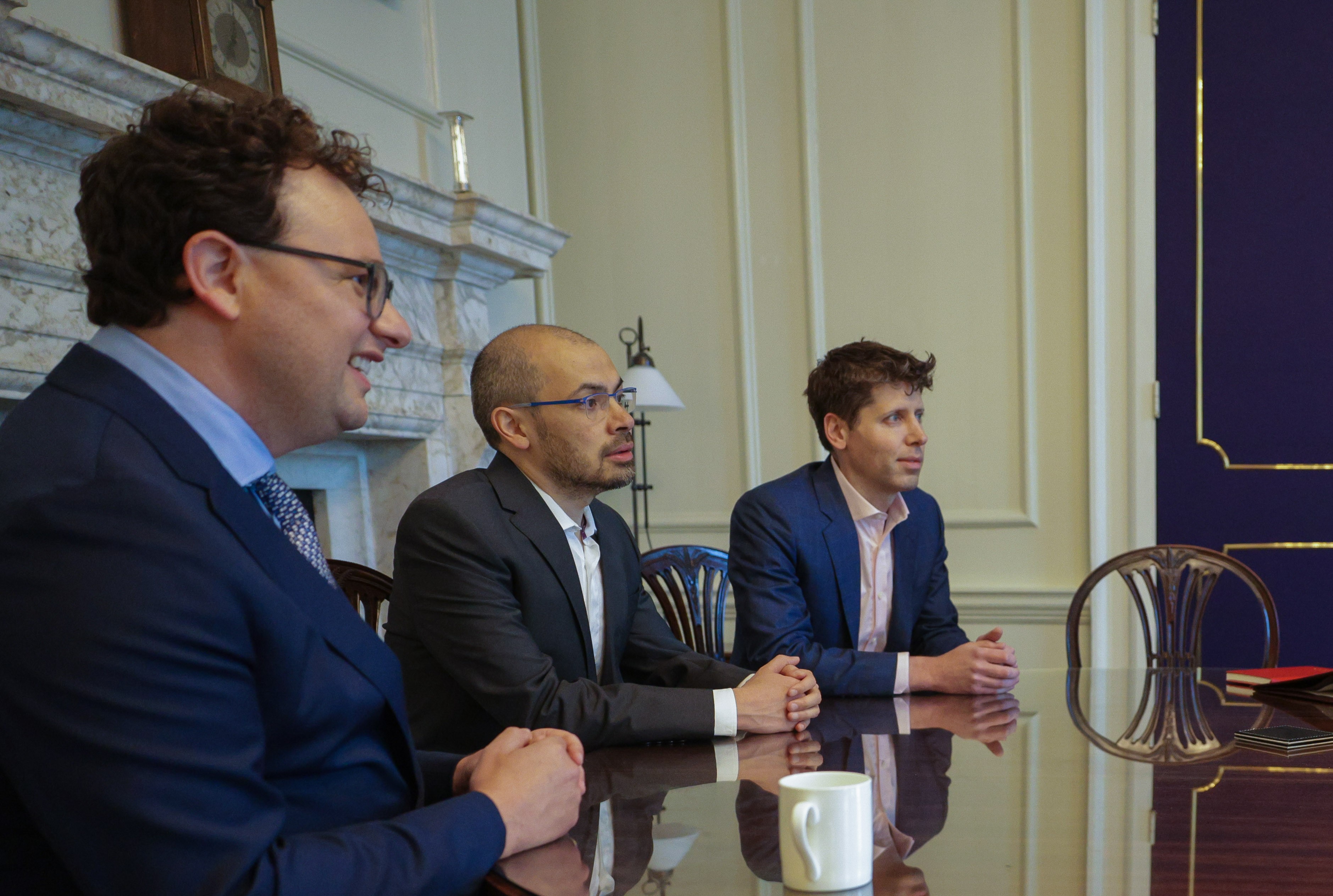
Header photograph. Simon Walker / Number 10, The Prime Minister meets with AI developers, 24 May 2023 — Rishi Sunak with the chief executives of OpenAI, Google DeepMind and Anthropic. CC BY 2.0, via Wikimedia Commons. Meeting readout: gov.uk.

Figure 1 — Annualised revenue run-rate
- Reuters, "OpenAI's annualized revenue hits $10 billion, up from $5.5 billion in December 2024", 9 June 2025.
- Anthropic, "Anthropic raises $13B Series F at $183B post-money valuation", 2 September 2025 — run-rate of roughly $1bn at the start of 2025, above $5bn by August.
- Reuters, "Anthropic hits $3 billion in annualized revenue on business demand for AI", 30 May 2025 — also $1bn in December 2024 and $2bn in March 2025.
- Reuters, "OpenAI hits $12 billion annualized revenue", 31 July 2025 — $12bn in July 2025, $13bn in August.
- OpenAI, "A business that scales with the value of intelligence", 18 January 2026 — OpenAI's own series: $2bn in 2023, $6bn in 2024, above $20bn in 2025.
- Anthropic, "Anthropic raises $30 billion in Series G funding at $380 billion post-money valuation", 12 February 2026 — run-rate of $14bn.
- Reuters, "OpenAI tops $25 billion in annualized revenue, The Information reports", 5 March 2026 — figure relates to end-February 2026 and was first reported by The Information, which Reuters could not independently verify.
- Anthropic, "Anthropic expands partnership with Google and Broadcom", 6 April 2026 — run-rate past $30bn, up from roughly $9bn at the end of 2025.
- Anthropic, "Anthropic raises $65B in Series H funding at $965B post-money valuation", 28 May 2026 — run-rate crossed $47bn earlier that month.
- Reuters, "Anthropic revenue run rate tops $65 billion, source says", 17 August 2026 — above $65bn by the end of July, against $47bn in May.
Figure 2 — "AI does more harm than good"
Gallup for Bentley University, "Americans Cool Toward AI", 28 July 2026. Business in Society survey; Gallup Panel web study of 3,270 US adults aged 18+, fielded 4–11 May 2026, margin of error ±2.4 points. Series shown: all adults 40/31/31/39% for 2023–26; 18-to-29-year-olds 30/27/36/47%.
The listings
- Anthropic's confidential draft S-1, submitted 1 June 2026 under Securities Act Rule 135 — company announcement.
- OpenAI, "Confidential submission of draft S-1 to the SEC", 8 June 2026.
- Financial Times, via Fortune, 13 August 2026 — six investors expect a $2 trillion-plus valuation in October; $100–120bn annualised expected by December; Morgan Stanley, Goldman Sachs and JPMorgan leading; no internal target fixed. The thirty-times-revenue argument appears in the same reporting, summarised at Quartz.
- OpenAI's $852bn March 2026 valuation — MLQ.
Capital and financials
- Sam Altman on X, November 2025, on $1.4 trillion of data-centre commitments over eight years — TechCrunch.
- CNBC, "OpenAI resets spending expectations, tells investors compute target is around $600 billion by 2030", 20 February 2026 — also $13.1bn of 2025 revenue and a roughly $280bn revenue target for 2030.
- ChatGPT weekly active users — eMarketer, December 2025.
Governance
- CNBC, "OpenAI completes restructure, solidifying Microsoft as a major shareholder", 28 October 2025 — OpenAI Group PBC under the OpenAI Foundation, which holds 26% and appoints the entire board; Microsoft roughly 27%; employees and investors 47%. See also Axios.
- The California and Delaware attorneys general both signed off on the restructuring after extracting commitments — Value Add.
- The Information, 18 August 2026, matched by Bloomberg and Reuters — Anthropic preparing super-voting stock for Dario Amodei and his co-founders, who hold small economic stakes; Amodei around 2%. Via Reuters/The Star.
- The Long-Term Benefit Trust's Class T shares, its power to elect a majority of the seven-member board, and its reduction to three trustees — TechTimes, 19 August 2026.
Pricing and consumers
- Anthropic, Claude Fable 5 and Claude Mythos 5 — $10 per million input tokens, $50 per million output.
- OpenAI developer pricing — GPT-5.6 Sol at $5 input and $30 output per million tokens; the flagship tier was unchanged in the 30 July 2026 cut that lowered the Terra and Luna tiers. Rate card summarised at OrcaRouter.
- OpenAI, "Testing ads in ChatGPT" — ads to US Free and Go tiers from 9 February 2026, self-serve Ads Manager from 5 May, and expansion to the United Kingdom, Mexico, Brazil, Japan and South Korea on 11 August 2026.
- Ramp data on enterprises reaching a ceiling on AI spend and shifting to lower-cost options — Quartz, August 2026.
SpaceX
Priced at $135 a share on 12 June 2026, raising roughly $75bn at about $1.77 trillion; an all-time high of $225.64 on 16 June; trading at $139.65 on 20 August 2026, below the issue price, after a post-earnings selloff and the first insider lockup expiry on 6 August. Investing.com; Tickeron.
Public sentiment
- NBC News, with Hart Research Associates and Public Opinion Strategies, "Poll: Majority of voters say risks of AI outweigh the benefits", 9 March 2026. 1,000 registered voters, 27 February–3 March 2026, ±3.1 points: 26% positive, 46% negative.
- Annenberg Public Policy Center, "Opposition to Local Data Centers Rises Sharply", 13 August 2026. 1,320 US adult citizens, 16 June–19 July 2026, fielded by SSRS: 61% oppose new local data centres, up 12 points; 68% say the government has done too little to regulate AI. Earlier wave: "Many Americans Pessimistic about AI's Impact", 13 May 2026.
- CNBC / Generation Labs, reported by Forbes, 13 August 2026. 1,088 Americans aged 18–34; 76% said they distrust Dario Amodei.